
The Physiology of a Sigh: How One Long Exhale Resets Your Brain

You are sitting quietly after a long, demanding day, and suddenly, without planning it, your lungs fill up and you let out a deep, heavy sigh. Your shoulders drop, your jaw relaxes, and for a brief second, the mental noise quiets down.
We often think of sighing as a sign of frustration or weariness. But in reality, an involuntary—or intentional—sigh is your body’s built-in reset button.
When your mind is overwhelmed, trying to “think your way into calm” rarely works. Your brain is too busy processing the day. But by understanding the physiology of a sigh, you can use a simple, physiological reflex to shift your nervous system from alert to peaceful in a matter of seconds.
“You don’t need a 30-minute meditation practice to find relief. Sometimes, all your nervous system needs is one long, intentional exhale.”
What Happens When You Sigh?
A physiological sigh is not just a regular breath. Biologically, it is a double inhalation followed by an extended exhale.
Throughout the day, under subtle stress, the microscopic air sacs in your lungs (called alveoli) slowly collapse. This reduces the surface area available for gas exchange, causing carbon dioxide ($CO_2$) to build up in your bloodstream. Your brain senses this accumulation and triggers an automatic urge to sigh.
Subtle Stress → Collapsed Air Sacs → CO₂ Accumulation → Physiological Sigh → Immediate Nervous System Reset
When you take that double breath in, the second quick gasp pops those tiny air sacs back open. And when you let out the long, slow exhale that follows, you dump the excess carbon dioxide and instantly change your heart rate.
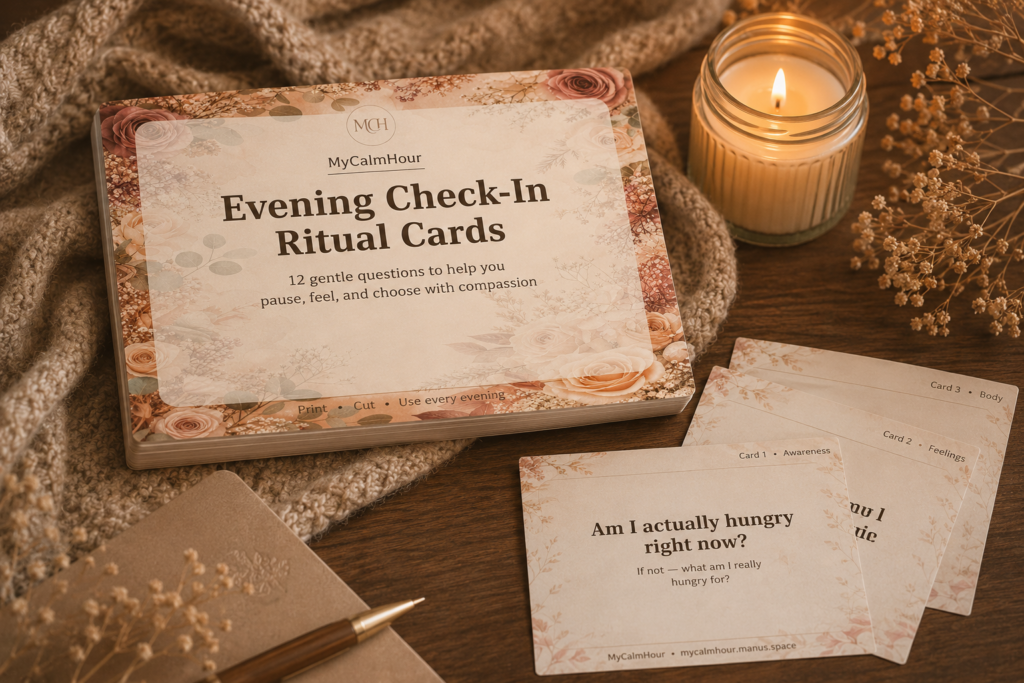
If this article resonated with you…
Pause before the craving takes over.
The Evening Check-In Ritual Cards offer 12 gentle prompts to help you slow down, reconnect with your emotions and respond with self-compassion instead of autopilot.
The Vagus Nerve & The Extended Exhale
The true magic of the sigh lies in the length of the exhale. Your heart rate and your breathing are intimately connected through a mechanism called Respiratory Sinus Arrhythmia:
- Inhalation: Your diaphragm moves down, creating more space in your chest cavity. Your heart expands slightly, blood flow slows down, and your brain signals the heart to speed up.
- Exhale: Your diaphragm moves up, compressing the heart cavity. Blood flows faster, and your brain sends a signal via the vagus nerve to slow the heart down.
When your exhale is noticeably longer than your inhale, you give the vagus nerve total control. Heart rate drops, muscle tension melts, and your brain receives a direct physical message: the danger is over; we are safe now.
Automatic Reaction vs. The Physiological Sigh
| Aspect | Fast, Shallow Breathing | The Physiological Sigh |
| Driven By | Sympathetic Nervous System (Fight or Flight) | Parasympathetic Nervous System (Rest and Digest) |
| Heart Rate | Elevated and erratic | Naturally slowed down |
| CO₂ Levels | Trapped in collapsed lung sacs | Efficiently released on the long exhale |
| Mental State | High alert, racing thoughts, urge to snack/react | Grounded, calm, present in the body |
How to Practice the “Double Inhale” Reset Tonight
You don’t have to wait for your body to sigh automatically. You can consciously trigger this reflex whenever you feel evening anxiety, restless cravings, or tension creeping in:
- Take a deep inhale through your nose, filling your lungs about 80%.
- Take a second, quick “pop” inhale at the very top to fully expand your lung capacity.
- Let out a long, slow, unhurried exhale through your mouth with a soft sighing sound (aaaaah).
- Repeat just 2 to 3 times.
Doing this just twice is often enough to instantly lower your heart rate and break the cycle of late-night stress.