
Guided Meditation for Evening Cravings That Helps

The kitchen can feel unusually loud at 9 p.m. The refrigerator hums, the day is finally over, and a part of you wants something sweet, salty, warm, or simply familiar.
A guided meditation for evening cravings is not a test of whether you can resist that pull. It is a way to pause long enough to understand what the pull is trying to do for you.
Often, the craving arrives after you have spent hours being needed, making decisions, answering messages, or holding yourself together. Food becomes the quickest route your nervous system knows toward comfort and a sense of arrival.
Remember: You are not broken for wanting relief. You may simply be tired.
Why Cravings Feel Strongest After Dark
Evening cravings are rarely about a lack of discipline. By the end of the day, your mind has less capacity for decisions, and your body is still carrying the momentum of daily stress.
Rushed Day & Constantly Needed ──► Evening Depletion ──► Urge for Quick Comfort (Food)
Food offers pleasure, predictability, and a welcome transition from doing to being.
Sometimes physical hunger is in the mix. Other times, it’s loneliness, frustration, restlessness, or the feeling that the day didn’t contain a single moment that belonged fully to you.
Arguing with a craving often makes it louder. A calmer approach begins with curiosity:
🌱 What is here beneath this urge? What kind of comfort am I hoping for right now?
What a Guided Meditation for Evening Cravings Can Do
Meditation will not erase every desire to eat, nor should it try to turn you into someone who never enjoys food for comfort. Its purpose is smaller and kinder: it creates a little space between the urge and your next move.
In that space:
- Your body comes down a notch from urgency.
- You may notice physical hunger and choose to eat with presence.
- You may recognize that you actually need a warm shower, a glass of water, or permission to rest.
Both outcomes count as listening to yourself. A two-minute pause can be deeply meaningful—you don’t need a long, perfect practice to receive support.
A Gentle Practice for the Moment a Craving Arrives
Try this 4-step practice before, during, or after eating. There is no wrong time to return to yourself.
1. Begin Where You Are
Sit in a comfortable chair, stand at the counter, or rest on the edge of your bed. Let your hands settle somewhere easy. Soften your gaze toward one spot in the room.
Say quietly to yourself:
“Something in me wants comfort right now.”
Take one unforced breath in, letting the exhale be slightly longer than the inhale. Repeat this twice. You are simply giving your body a signal that this moment is not an emergency.
2. Name the Urge Without Becoming It
Bring your attention to the craving itself. Where do you feel it? In your mouth, chest, stomach, throat, or as a restless energy? Describe the sensation plainly: tight, buzzy, hollow, warm, urgent, or heavy.
Then try this phrase:
“I am noticing a craving. I am not the craving.”
An urge can be intense without being a command. Imagine you are sitting next to a tired friend who has had a long day. Your task is not to fix her—it is simply to stay.
3. Ask What the Evening Has Been Holding
Ask yourself one or two gentle questions without forcing an answer:
- What has felt hard today?
- What am I needing more of right now: comfort, quiet, connection, rest, or nourishment?
- Have I had enough space to be a person today, not just someone who gets things done?
Sometimes the most honest answer is simply: “I don’t know, but I know I need gentleness.”
4. Choose the Next Kind Thing, Not the Perfect Thing
Place a hand over your chest or abdomen. Tell yourself: “I can take care of this moment one gentle step at a time.”
Now decide what would support you next:
- If physically hungry: Prepare something satisfying and eat it without turning it into a moral question.
- If emotionally depleted: You might still eat, or you might add another form of comfort first—make tea, put on soft music, text a friend, or wrap yourself in a blanket.
          ┌──► Physical Hunger ──────► Eat Satisfying Food
Craving ──┤
          └──► Emotional Need ───────► Add Non-Food Comfort First (Tea, Blanket, Quiet)
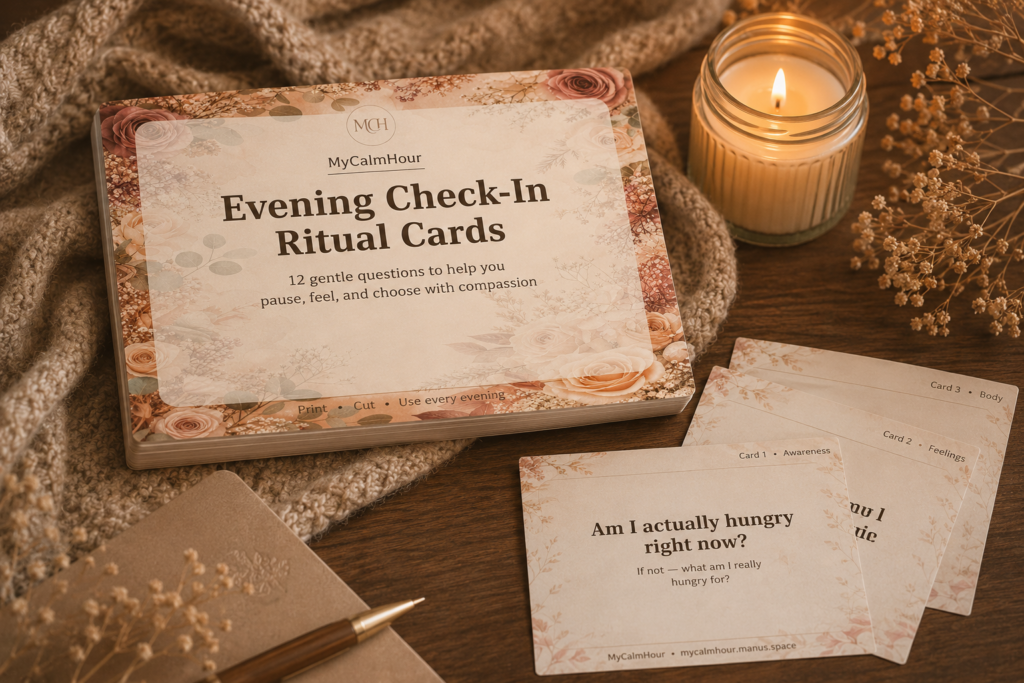
If this article resonated with you…
Pause before the craving takes over.
The Evening Check-In Ritual Cards offer 12 gentle prompts to help you slow down, reconnect with your emotions and respond with self-compassion instead of autopilot.
When the Meditation Doesn’t Change the Craving
There will be evenings when you pause, breathe, and still want the snack. This does not mean the practice failed.
The value is that you met the moment with less fear and more awareness:
- You noticed your exhaustion.
- You stopped criticizing yourself.
- You ate what you wanted while feeling a little less alone in the process.
Make the Pause Easier to Remember
Consider creating one visible cue for your evening pause:
- A small note on the pantry door.
- A meditation cushion near the couch.
- A phone reminder with caring words rather than rules.
Keep the cue simple: Pause first. Then choose.
At My Calm Hour, we believe the goal is not to win a nightly battle. It is to create enough safety that you no longer have to abandon yourself when the day gets heavy.