
How to Choose the Best Emotional Eating Workbook

The best emotional eating workbook is not necessarily the one with the most pages, the prettiest design, or the boldest promise. It is the one that helps you pause at the moment you usually reach for food and meet yourself with understanding.
Especially in the evening, when your energy is low and the day has asked a lot of you, compassionate support matters far more than another set of strict rules.
A thoughtful workbook cannot erase stress or make cravings disappear on command. What it can do is give shape to experiences that often feel confusing: the restless feeling after dinner, the urge for sweetness after a difficult conversation, or the sense that food is the only part of the day that belongs entirely to you.
What Makes an Emotional Eating Workbook Helpful?
Emotional eating is often described as a “lack of control.” For most people, it is more accurately a form of coping. Food offers comfort, distraction, reward, grounding, or a brief transition out of a demanding day.
Stressful/Demanding Day ──► Depleted System ──► Search for Comfort ──► Eating (Fast Coping)
A useful workbook begins with compassion:
- It does not treat your behavior as a character flaw.
- It helps you get curious about what the behavior has been trying to do for you.
- It leaves room for context (because a craving means different things on different nights).
The strongest resources do not force every experience into one explanation. Instead, they offer gentle prompts that help you notice patterns over time.
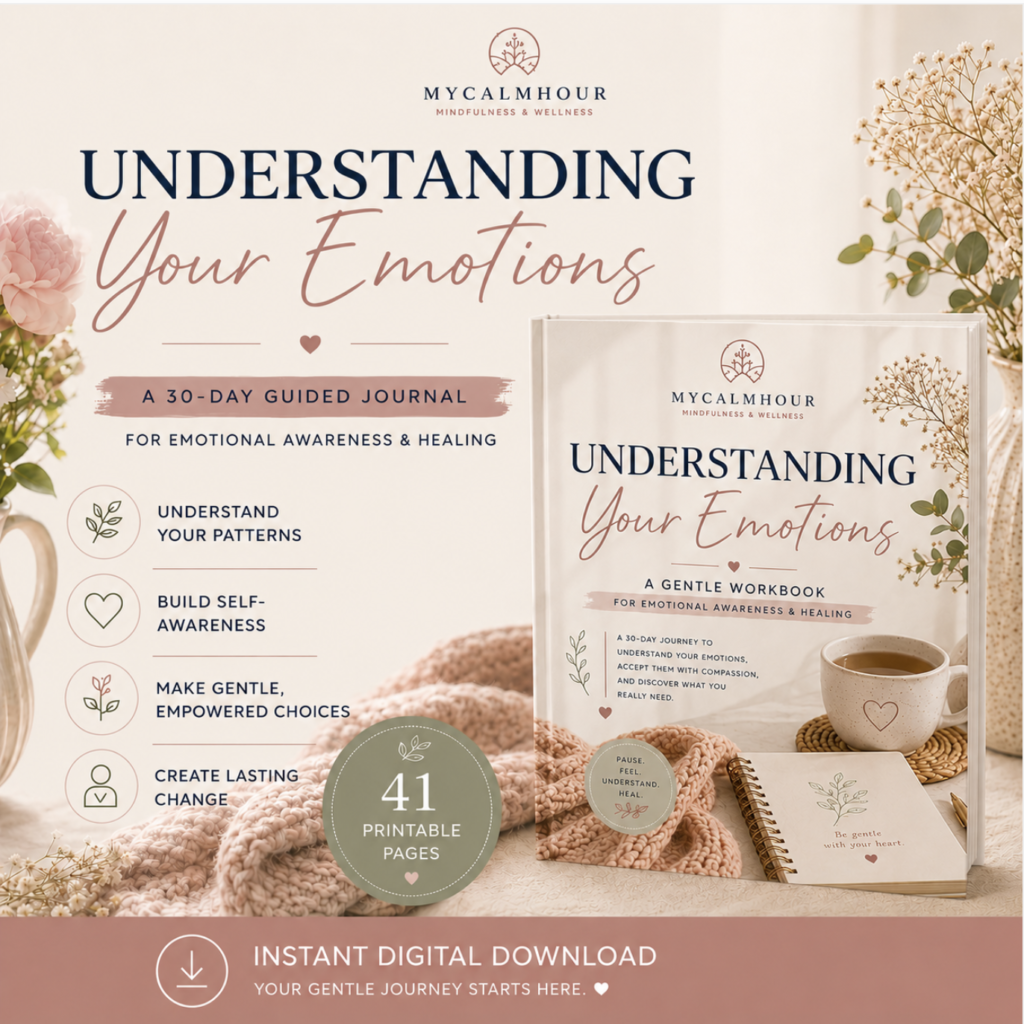
If this article resonated with you…
Every emotion has something to tell you.
The Understanding Your Emotions Journal gently guides you through 30 days of reflection to help you recognize emotional patterns, build self-awareness and respond with greater compassion.
Key Features to Look For
| Rigid / Rule-Based Workbook ❌ | Compassionate & Supportive Workbook 🌱 |
| Focuses on “fixing” you or correcting behavior. | Speaks to a human nervous system seeking relief. |
| Uses language that triggers guilt or self-criticism. | Creates enough emotional safety for honesty. |
| Focuses purely on food logging and calories. | Includes the physical body, nervous system, and emotions. |
| Requires long, exhausting daily journal entries. | Offers brief, 2-minute repeatable prompts. |
1. It Should Include the Body, Not Only Thoughts
Evening eating is rarely solved by thinking differently. After a stressful day, your body may be exhausted, wired, or overstimulated.
The best emotional eating workbook invites you to notice physical signals alongside your feelings:
- What am I noticing in my jaw, shoulders, or stomach?
- How rushed has this evening felt?
- What kind of comfort am I hoping this food will provide?
2. It Should Be Brief and Repeatable
A long, deep reflection can be meaningful on a quiet Sunday morning, but it is unrealistic at 9:30 p.m. Look for daily check-ins that ask 2–3 clear, simple questions.
Powerful Questions Worth Seeing Inside a Workbook
Before buying or choosing a workbook, preview the types of questions it asks. The most helpful prompts tend to move gently from the immediate moment toward deeper self-awareness:
💬 5 Prompts for Evening Awareness:
- “What happened today that took more out of me than I realized?”
- “What feeling am I trying not to feel right now?”
- “What do I need most: nourishment, comfort, rest, connection, or a pause?”
- “If I could offer myself support before deciding what to eat, what would feel kind?”
- “What helped, even a little, after the urge passed?”
Notice that none of these questions demand that you stop eating. That is intentional. When you remove the pressure to perform, you can observe what is actually happening.
How to Use a Workbook When Evenings Are Hard
A workbook is most useful when it becomes part of a gentle wind-down ritual, rather than a task saved for moments of total overwhelm.
Visible Location (Near Couch/Bed) ──► 2-Minute Pause ──► Answer 1 Prompt ──► Softened Energy
- Keep it visible: Place it beside the couch, near the tea kettle, or on your nightstand.
- Start small: Take a 2-minute pause. Put a hand on your chest, take one slow breath, and answer a single prompt. Even writing “Today felt loud” is enough.
- If you are already eating: It is not too late! Bring the notebook beside you and write one line about what the food is offering you in that moment (Comfort? A break? Warmth?). Naming the need softens the all-or-nothing mindset.
When a Workbook May Not Be Enough
A workbook is a meaningful companion, but it is not meant to hold every difficult experience alone. If eating feels frightening, intensely compulsive, or connected to distress that feels too heavy to carry, reaching out to a qualified mental health professional is a crucial form of care.
For many, however, a workbook creates a quiet beginning. It transforms the inner narrative from “What is wrong with me?” to:
🌱 “What has today been like for me?”
The right workbook will not ask you to become a different person by tomorrow. It will simply help you stay close to yourself in the moments you most want to disappear. One honest page, one softer pause, one gentle hour at a time.