
How to Stop Stress-Eating Without Starting Another Diet
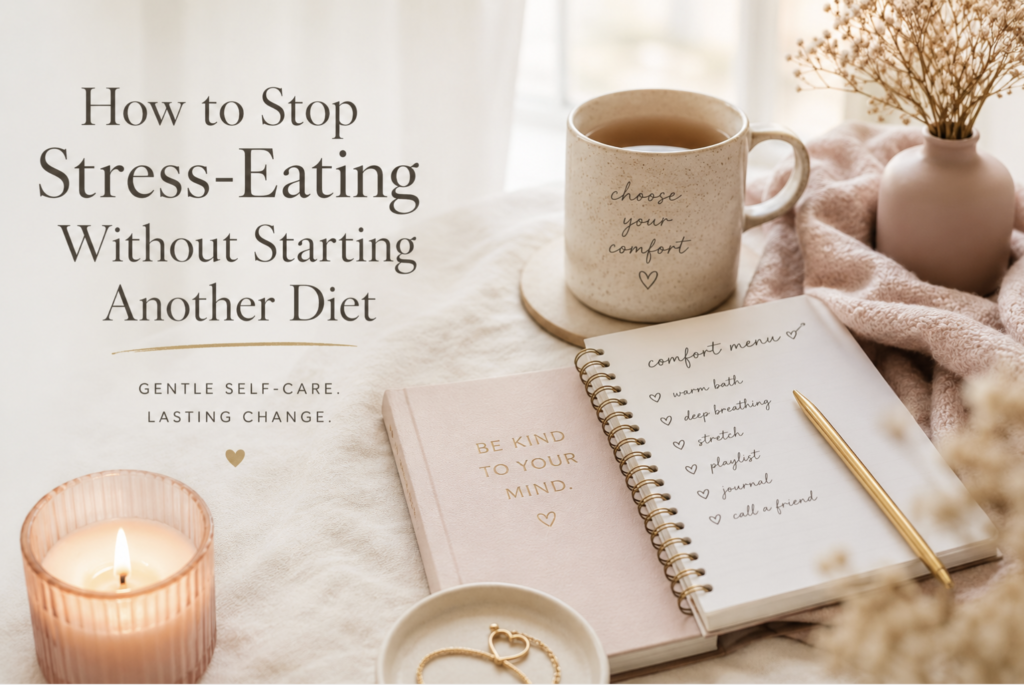
We’ve all been there. A stressful email arrives, a deadline looms, or the kids are particularly demanding, and suddenly you find yourself reaching for a bag of chips or a chocolate bar. In the moment, the food provides a sense of relief. But afterward, the stress remains, often accompanied by a heavy dose of guilt.
The traditional advice for managing stress-eating is usually some form of restriction: “Just go on a diet,” “Use more willpower,” or “Clear your pantry of junk food.” But if you have tried these methods, you know they rarely work long-term. In fact, dieting often makes stress-eating worse.
Here is how to stop the cycle of stress-eating with gentle self-care and emotional regulation, without ever starting another restrictive diet.
Why Dieting Makes Stress-Eating Worse
Dieting inherently involves restriction, rules, and often, deprivation. When you restrict your food intake, you increase both physiological and psychological stress.
1.Physiological Stress: Caloric restriction signals to your body that food is scarce. This triggers a survival mechanism that actually increases your cravings for high-calorie, energy-dense foods.
2.Psychological Stress: Labeling foods as “good” or “bad” creates a restrictive mindset. When you inevitably eat a “bad” food, you feel like you have failed, which triggers more stress and, consequently, more emotional eating.
Dieting does not address the root cause of stress-eating; it only adds more stress to your already overwhelmed nervous system.
The Neuroscience of Stress-Eating
To change the habit, we must understand why it happens. When you experience stress, your body releases cortisol. This hormone prepares you for a “fight or flight” response, requiring quick energy. Historically, this meant running from a predator. Today, it usually means sitting at a desk dealing with psychological pressure.
However, your body still craves that quick energy, typically in the form of sugar and carbohydrates. Furthermore, eating these comfort foods releases dopamine, providing a temporary feeling of reward and safety in the brain’s mesolimbic system .
You aren’t lacking willpower; your brain is executing a highly effective, biologically ingrained strategy to soothe distress.
Strategies to Stop Stress-Eating Without Dieting
Instead of restriction, the key to overcoming stress-eating lies in adding resources—specifically, tools for emotional regulation and nervous system support.
1. Build Interoceptive Awareness
Interoception is your ability to feel and understand what is happening inside your body. Chronic stress often disconnects us from our bodily sensations. Mindfulness practices can help rebuild this connection.
Research shows that mindfulness meditation can significantly reduce stress-eating by increasing interoceptive awareness . Before you eat, take a moment to notice the physical sensations in your body. Are your shoulders tight? Is your breathing shallow? Recognizing the physical signs of stress can help you separate the feeling of anxiety from the feeling of hunger.
2. Feel the Emotion, Don’t Feed It
Stress-eating is often an attempt to numb or distract from uncomfortable emotions. To move past it, you must allow yourself to feel the emotion.
When you feel the urge to stress-eat, try the “Name It to Tame It” technique. Say to yourself, “I am feeling incredibly overwhelmed right now.” Acknowledging the emotion validates your experience and often reduces its intensity, making the urge to eat less powerful.
3. Develop a “Comfort Menu”
Food is a valid form of comfort, but it shouldn’t be your only form of comfort. Create a list of non-food activities that genuinely soothe you. Your “Comfort Menu” might include:
•Taking a warm shower or bath
•Listening to a specific calming playlist
•Doing 5 minutes of gentle stretching
•Calling a supportive friend
•Writing your frustrations in a journal
When stress hits, choose an item from your menu before turning to the pantry.
4. Practice Self-Compassion
Perhaps the most important step is removing the shame associated with stress-eating. Shame is a powerful stressor. When you judge yourself harshly for eating, you trigger the exact stress response that leads to more eating.
If you do stress-eat, practice self-compassion. Tell yourself, “I ate because I was stressed, and that makes sense. It’s a coping mechanism I’ve used for a long time. I am learning new ways to cope, and that takes time.”
Moving Forward
Stopping stress-eating is not about achieving perfect dietary compliance. It is about learning to listen to your body, understanding your nervous system, and treating yourself with the same gentle care you would offer a good friend. By focusing on emotional regulation rather than food restriction, you can find true comfort and lasting peace with food.
Looking for more gentle tools? Visit our Free Resources page to download printable guides and calming worksheets.
References
[1] Emotional Eating and How to Stop It. HelpGuide.org. Available at:
[2] Probing the Neurobiology of Emotional Eating. Harvard Brain Science Initiative. Available at: