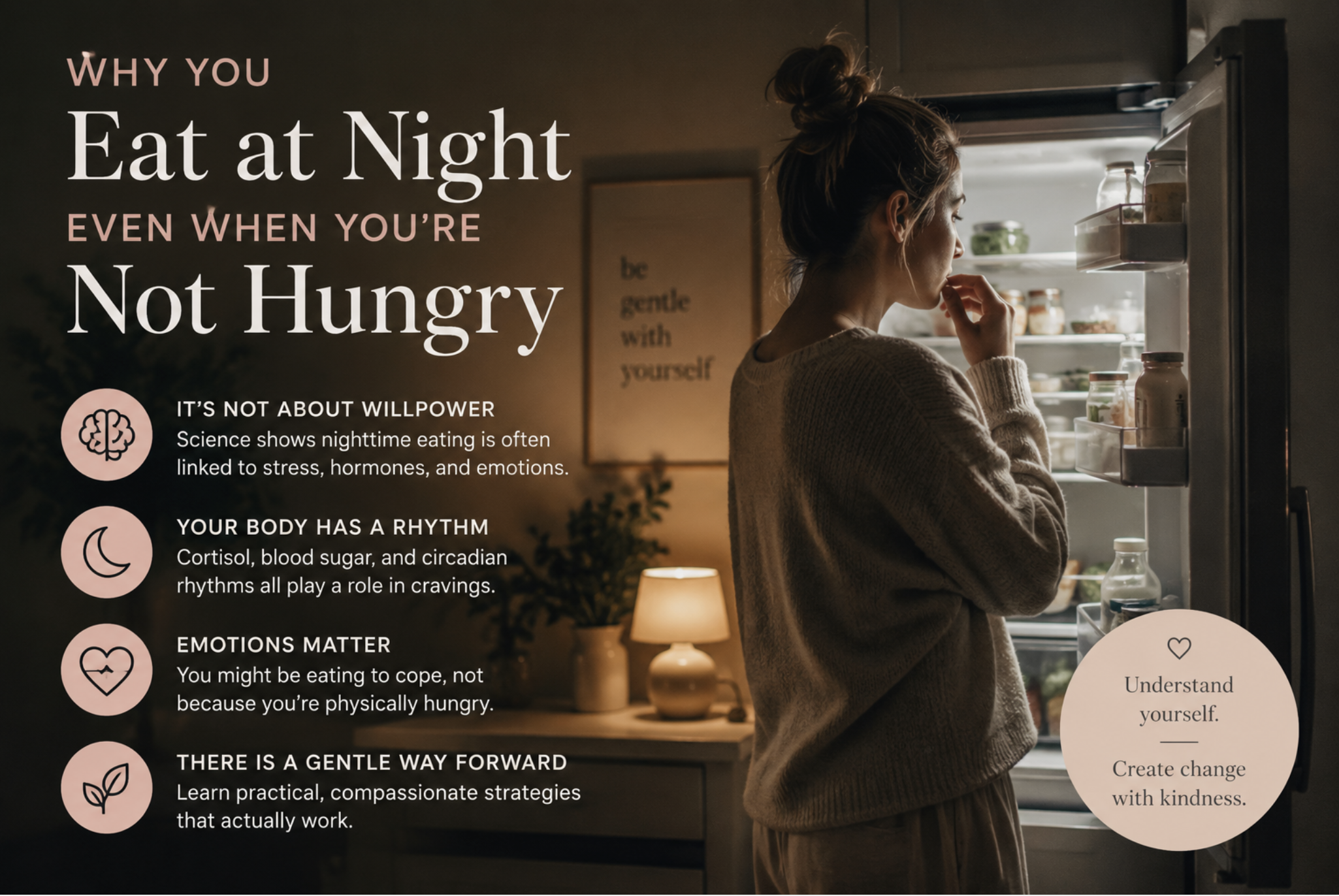
Why Nighttime Cravings Feel So Powerful(And What They’re Really Trying to Tell You)

If you have ever stood in the kitchen at night wondering why your cravings suddenly feel louder than your own good intentions, you are not alone. Why Nighttime Cravings Feel So Powerful (And What They’re Really Trying to Tell You) has less to do with lack of discipline and far more to do with what your body and nervous system have been carrying all day.
For many people, evening eating is not random. It happens at the exact moment the house gets quiet, the workday ends, and the pressure you held together for hours finally starts to leak out. That is why nighttime cravings can feel so intense, so urgent, and so confusing. They are often doing something important for you, even if that something does not feel helpful in the long run.
Why nighttime cravings feel so powerful at the end of the day
Cravings tend to get stronger at night because this is when your body is most likely to ask for relief. During the day, structure can carry you. Meetings, errands, caretaking, deadlines, and constant stimulation keep you moving. But once evening arrives, your system finally has a chance to notice how tired, underfed, lonely, overstimulated, or emotionally stretched you really are.
Food is a fast and familiar form of support. It brings pleasure, grounding, distraction, and comfort in a matter of minutes. If your nervous system has been running on stress for most of the day, of course it will reach for the thing that feels soothing and immediate.
This is one reason the inner dialogue can feel so painful at night. Part of you wants rest. Part of you wants comfort. Part of you wants to feel in control. When those needs collide, cravings often get mistaken for failure, when they may actually be a message.
What nighttime cravings are really trying to tell you
Not every craving means the same thing. Sometimes your body is asking for energy. Sometimes your emotional world is asking for care. Often, it is both.
You may need more physical nourishment
A very common reason cravings hit hard at night is simple: your body has not had enough consistent nourishment during the day. Maybe breakfast was rushed, lunch was delayed, or stress made it hard to notice hunger cues. By evening, your body is trying to catch up.
When this happens, cravings often lean toward quick comfort foods because your system wants fast energy and maximum relief. This is not your body being dramatic. It is your body being protective.
If nighttime eating feels chaotic, it can help to gently look backward before judging the moment itself. Did you go long stretches without eating? Did stress shut down your appetite until later? Did caffeine carry you through the day while your actual needs stayed in the background? These patterns matter.
You may be craving emotional decompression
Evening is often the first time people stop performing. You are no longer answering emails, helping everyone else, or checking things off. That quiet can feel peaceful, but it can also feel exposing.
Cravings sometimes appear when the body senses, at last, that it can soften. Sweet or crunchy foods can become part of a transition ritual – a way to mark that the hard part of the day is over. In that sense, the craving may not be about food alone. It may be about permission to exhale.
This is especially true if you often think, “Food is the only thing that helps me relax.” If that feels familiar, the craving is not silly or weak. It is a sign that your system has learned one reliable path toward comfort.
You may need sensory soothing
Not all cravings are emotional in a dramatic sense. Some are sensory. After a long day of screens, noise, decision-making, and emotional labor, your brain may crave a shift in sensation. Warm, creamy, salty, crunchy, cold, sweet – these experiences can regulate more than we realize.
Food gives texture, rhythm, and predictability. It can pull attention out of spiraling thoughts and into the body. That is part of why eating at night can feel calming even when you were not physically hungry to begin with.
You may be trying to fill an unmet need that has no words yet
Sometimes a craving shows up before insight does. You may not immediately know whether you feel lonely, bored, resentful, depleted, disconnected, or touched-out. You only know that something in you is reaching.
This is where self-compassion matters most. If you rush to control the craving without understanding it, you miss the deeper signal. But if you pause with curiosity, you begin to learn your own emotional language.
The stress connection most people miss
Stress does not only live in the mind. It shapes appetite, energy, impulse control, and the ability to pause before reacting. When you have been in survival mode all day, your brain is less interested in long-term ideals and more interested in immediate comfort.
That is why nighttime cravings can feel almost automatic. They are often strongest when your nervous system is tired, not when your character is weak.
A dysregulated evening can also create a pattern: stress all day, cravings at night, shame afterward, and then even more stress the next day. This cycle can make it seem like the real problem is food, when the deeper issue is a body that rarely feels safe enough to rest.
Understanding this can soften a lot of self-blame. You are not broken. Your system may simply be asking for support in the only way it knows how.
How to respond without fighting yourself
If cravings are trying to tell you something, the goal is not to silence them through force. The goal is to listen more clearly, then respond with a little more care.
The first helpful question is not, “How do I stop this?” It is, “What might I need right now?” Sometimes the answer really is food. Sometimes it is food plus rest. Sometimes it is a transition ritual, a few quiet minutes, a glass of water, a proper dinner, a shower, or a moment alone before tending to anyone else.
This kind of pause matters because it moves you out of self-attack and into self-contact. Even if you still eat, the experience changes when it comes with awareness instead of panic.
A gentler way to work with nighttime cravings
When an evening craving appears, try not to treat it like an emergency. Slow the moment down just enough to notice what is happening inside you.
You might ask yourself a few simple questions. Am I physically hungry? When did I last eat something satisfying? What kind of day have I had? Do I want comfort, stimulation, numbness, reward, or rest? What would feel genuinely supportive in the next ten minutes?
You do not need perfect answers. The practice is in asking.
Then, if it helps, add one small layer of care before reaching for food. Sit down. Take three slower breaths. Put on softer lighting. Drink something warm. Step away from the noise of the day. These are not tricks to make the craving disappear. They are signals of safety that can help your body feel less frantic.
Over time, evening rituals can become powerful here. A predictable wind-down routine teaches the nervous system that comfort is available in more than one form. Maybe that looks like a real dinner eaten without multitasking, ten minutes of journaling, music while you clean the kitchen, or changing into soft clothes before the craving wave hits. Small repetitions matter.
At My Calm Hour, this is the deeper invitation behind evening wellbeing. Not perfection. Not control. Just learning, one gentle hour at a time, how to meet yourself before the craving has to shout.
When cravings are a signal, not an enemy
One of the most healing shifts is realizing that cravings are not always something to beat back. Very often, they are information. They may be pointing to exhaustion, emotional loneliness, skipped nourishment, overstimulation, or a lack of soothing in your evenings.
When you begin to hear that message, your relationship with night can start to change. The kitchen becomes less of a battleground. The craving becomes less of a moral test. And you get to respond from a place of understanding instead of shame.
Tonight, if the pull toward food feels especially strong, try asking a softer question than usual. Not “What is wrong with me?” but “What has this day asked of me, and what do I need now?” That question alone can begin to turn nighttime cravings into something more honest, more workable, and far less lonely.